Everything about Yalda Night | The Sun’s Rebirth
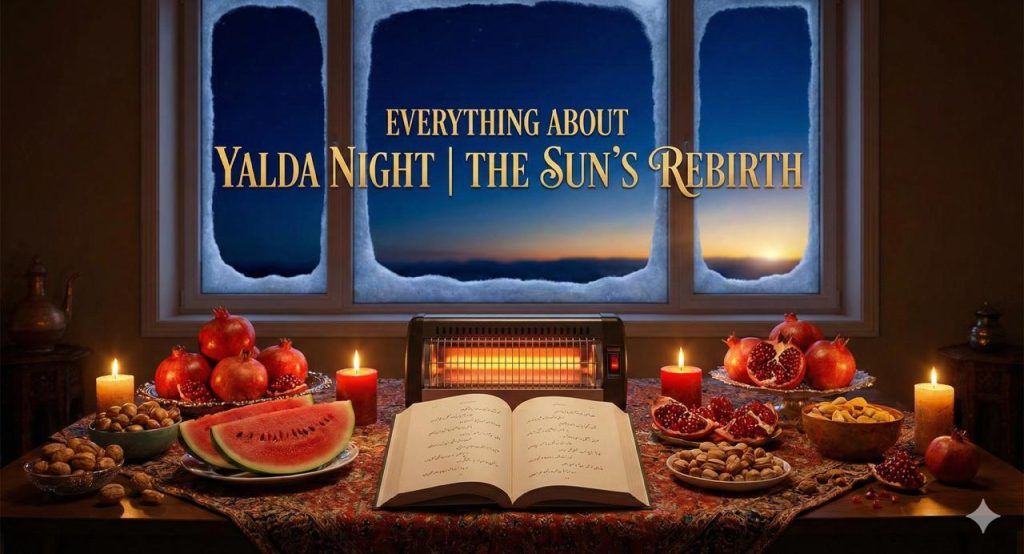
Welcome to the longest night of my homeland.
The Living Tradition – How Iran Defies the Darkness Today
While the world knows the Winter Solstice as a purely astronomical event, in Iran, it is the heartbeat of a culture. Yalda Night (Shab-e Yalda), historically rooted in the depths of antiquity, has evolved into a modern celebration of resilience, warmth, and kinship. It is the longest night of the year—technically stretching just a minute longer than others—spanning the last sunset of autumn to the first sunrise of winter. But for Iranians, that single extra minute is reason enough to keep the lights on and the conversations flowing.
The Anatomy of the Night
In contemporary Iran, Yalda is synonymous with gathering. It is a defiant act of togetherness against the cold. Families congregate at the home of the elders, creating a circle of warmth. The centerpiece of this gathering is the “Night Grazing” (Shab-Chereh). The table is a vibrant mosaic of colors, dominated by the red of pomegranates and watermelons—symbols of the sun’s glow and the cycle of life.
The night is not merely about eating; it is about seeking wisdom. The rituals include reading poetry, specifically from the Divan of Hafiz. A respected elder usually takes the volume, breathes a wish, and opens it at random. The poem found on the page is interpreted as a divination (Fal-e Hafiz), predicting the fortunes of the listeners for the coming year.
The Ritual of Love
Chell-ei Yalda holds a special significance for couples who are betrothed but not yet living together. This tradition, often called “Chell-ei,” places the bride and groom at the center of attention.
It is customary for the groom’s family to prepare elaborate trays known as Khoncha. These are laden with gifts for the bride—ranging from winter coats and shoes to household appliances that will eventually form part of her dowry (Jahiziyeh). In return, the bride’s family often reciprocates with gifts for the groom. This exchange is not just material; it is a social solidification of the new bond during the year’s most auspicious night.
A Tapestry of Regional Customs
While the core of Yalda is shared, the nuances vary beautifully across the Iranian map, painting a picture of cultural diversity:
The Northwest – Azerbaijan
Here, the night is celebrated with distinct local flair. The groom sends the Khoncha to the bride, but the menu differs. Locals consume “Chilla Garpizi” (Yalda Watermelon) to immunize themselves against the winter chill. They cook Khashil (a nutrient-rich porridge) for strength and engage in “Bayati” (folk couplets) singing.
Khorasan – The East
Perhaps one of the most unique rituals is “Kaf-zani” (Foam Beating). The roots of the Chubak plant are soaked and boiled, then beaten by the men of the family in large pottery vessels until they form a thick, hard foam. This foam, sweetened with sugar and garnished with walnuts, is treated like a localized ice cream or meringue, often playfully thrown at one another before being eaten.
Hamedan
The province is famous for Fal-e Suzan (Needle Divination). After an elder woman recites poetry, a young child sticks a needle into a piece of uncut cloth. The poem being read at that precise moment becomes the fortune for the guest designated by the needle’s position.
Qazvin
Here, folklore takes center stage. Elders tell tales of “Nane Sarma” (Grandma Frost). It is believed that if she cries, it rains; if her quilt cotton spills, it snows; and if her pearl necklace breaks, hail will fall.
Isfahan
The Isfahanis traditionally divide the winter into two “Chillas” (forty-day periods). Yalda heralds the arrival of the “Great Chilla.” The night is sometimes personified as “Chilla Zari” or “Uncle Chilla,” emphasizing the dual nature of the cold season.
Shiraz
In the city of poetry, the menu is balanced by temperament. “Warm” natured foods like dates and Ranginak are served to those with “cold” temperaments, while citrus and watermelon cool down the “warm” tempered guests, all accompanied by the inevitable recitations of Hafiz at his spiritual home.
The Ancient Soul – Roots, Etymology, and Cosmic Philosophy
To understand Yalda is to look back thousands of years, long before the modern calendar was codified. It is one of the few celebrations, alongside Nowruz (New Year), that stands as a living fossil of Iran’s ancient history.
Etymology and the “Great Birth”
The word “Yalda” itself is not Persian in origin; it is a Syriac word imported into the Persian language by early Christians living within the Persian Empire. It translates simply to “Birth.” But whose birth?
According to the great polymath Al-Biruni, writing in works like Al-Athar al-Baqiyah, this night was known as “Milad Akbar” (The Great Birth)—signifying the birth of the Sun. In the Mithraic tradition, it was believed that Mithra (the god of light and truth) was born from a rock on this longest night, bringing hope to a frozen world.
The alternative name, Shab-e Chelleh, refers to the concept of the “Forty” (Chehel). The ancient calendar divided winter into the “Big Chelleh” (starting the day after Yalda for 40 days, representing the harsh winter) and the “Small Chelleh” (the subsequent 20 days). Yalda is the threshold that ushers in this period.
The Cosmic Battle
Light vs. Darkness The philosophy behind Yalda is rooted in the dualism of ancient Iranian thought. The lives of early agrarian societies were dictated by the sun. Winter, darkness, and cold were associated with Ahriman (the chaotic, evil spirit), while the sun and light were symbols of the Creator (Ahura Mazda).
The logic was profound yet simple: The last night of autumn is the peak of darkness’s power. It is the longest the night will ever be. However, the very next morning marks a turning point. From the day after Yalda, the days begin to lengthen, minute by minute. Therefore, Yalda is not a celebration of darkness, but a celebration of the triumph of light. The sun is “reborn,” growing stronger every day until the spring equinox.
Historical Resilience
This celebration was officially integrated into the Iranian calendar around 500 BC, during the reign of Darius I. It was synchronized with the Babylonian and Egyptian solstices but retained its distinct Persian character.
Throughout history, the custom of staying awake was a protective measure. People believed that by gathering together, lighting fires (which later became the Korsi and modern heaters), and eating “bled” fruits like pomegranates (the red color symbolizing the glow of dawn/fire), they could ward off the demons of darkness that prowled during this long night.
From the “Kaf-zani” of Khorasan to the “Needle Divination” of Hamedan, the core message remains unchanged across millennia: No matter how long the darkness lasts, the sun will always rise again.